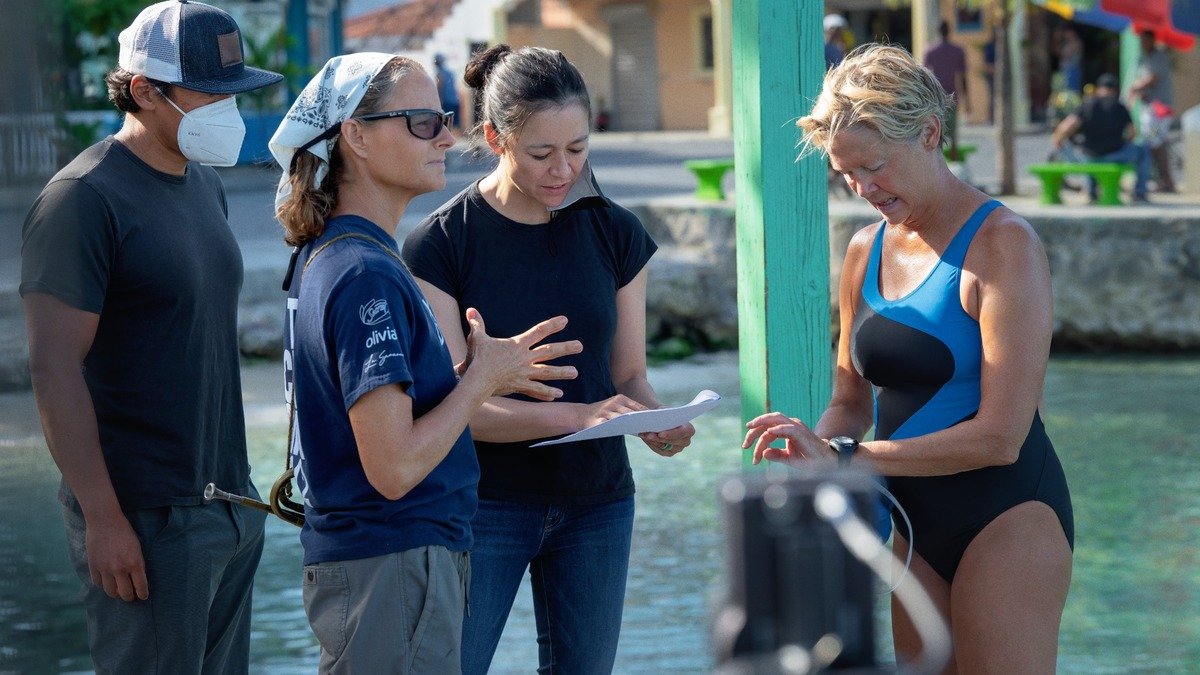
Elizabeth Chai Vasarhelyi is probably my biggest inspiration among directors working today – particularly because her move into narrative filmmaking with the 2023 sports drama Nyad felt significant for reasons that went far beyond simple career progression.
For years, mainstream survival and adventure cinema has largely been dominated by male protagonists. Mountains, oceans, wilderness, and extreme physical environments have traditionally been framed through conquest, ego, domination, or lone-wolf mythology. Even some of the genre’s most celebrated films position emotional vulnerability as secondary to spectacle. The scale is remarkable, sure, but I’ve always wondered where the space has been for inspiring, adrenaline-fuelled, against-all-odds outdoor stories centered on women – stories that feel just as cinematic, emotional, dangerous, and commercially viable.
Honestly, it increasingly feels like there’s room for an entirely niche production arm devoted specifically to these kinds of “women in the wild” stories. And if there’s any filmmaker whose work quietly suggests that possibility already exists, it’s Vasarhelyi. That’s partly why her pivot into Nyad felt so important.
Because while Hollywood still feels slow to fully tap into female-led survival and adventure storytelling, Vasarhelyi had already spent years documenting obsession, endurance, risk, and emotional survival through documentaries like Oscar-winning Free Solo, Meru, and The Rescue.
Yet even alongside longtime directing partner and former husband Jimmy Chin, her POV within those male-fronted environments has consistently felt different from that of many traditional, outdoors-focused filmmakers.
Her films rarely focus solely on physical achievement. Instead, they gravitate toward what extreme environments psychologically expose: fear, intimacy, emotional isolation, grief, obsession, identity, and the cost of ambition.
In Free Solo, Yosemite’s towering cliffs became psychological pressure points as much as physical obstacles for climber Alex Honnold. In Meru, the Himalayas reflected mortality, trauma, and unfinished emotional business. In The Rescue, claustrophobic cave systems heightened impossible moral decisions and fear itself.
That emotional perspective is precisely what made Nyad feel like such a natural, and full-circle next step.
Based on Diana Nyad’s real-life attempt to swim the 110 miles from Cuba to Florida at age 64, the film still carries the DNA of Vasarhelyi’s documentary work: endurance, survival, obsession, and physical extremes. But it reframes those themes through a female lens rarely prioritized in mainstream adventure storytelling.
Importantly, Nyad isn’t interested in presenting invincibility. The story focuses far more on persistence, aging, unfinished ambition, friendship, emotional resilience, and the complicated relationship women often have with proving themselves in spaces historically dominated by men. And audiences have already shown there is an appetite for these stories.
Films like Wild, Tracks, and True Spirit, as well as elements of Nomadland, demonstrate growing interest in female-led stories rooted in movement, survival, self-discovery, and physically demanding environments. Yet, compared to male-led adventure narratives, those films remain surprisingly underrepresented in mainstream cinema. Just think about the impact of Into The Wild, The Revenant, Everest, Castaway, Life Of Pi, 127 Hours …
What Vasarhelyi’s career increasingly suggests is that audiences are responding not simply to outdoor stories but to emotionally immersive storytelling in which landscapes become extensions of internal conflict. Her work understands the vulnerability of environmental backdrops.
That’s why Nyad perhaps feels like the clearest indication yet that her storytelling approach can successfully transition into larger-scale narrative filmmaking – and potentially help open the door for more female-led endurance and survival stories to exist within mainstream feature cinema. And honestly, that possibility feels exciting.
There are still so many remarkable female stories within exploration, mountaineering, endurance, and survival that rarely receive the same cinematic attention as their male counterparts. Whether it’s the climbers connected to Pakistan’s K2, British explorer Mollie Hughes’ polar expeditions, or Barbara Washburn dedicating years of her life to mapping the Grand Canyon for National Geographic, there is an entire world of “women in the wild” stories that still feels relatively untapped onscreen.
Which is exactly why the idea of a more dedicated production space for female-led outdoor storytelling feels increasingly compelling. Not just because the stories exist, but because audiences are already proving they want emotionally grounded survival narratives that look beyond spectacle alone and ignite that fearless spark in them, the belief that they can do anything they put their mind to.
The future of female-led adventure and survival storytelling no longer feels niche — it feels necessary, and in my opinion, Elizabeth Chai Vasarhelyi has played a huge role in pushing that evolution forward with her Little Monster Films.