“I’m so sorry, I’ll be there soon, the trains are just so messed up!”
I sighed, staring down at the text from the make-up artist I had booked for my brother’s wedding the week before. She was already an hour late, and while it was frustrating, I couldn’t quite bring myself to get truly riled up about it.
After all, I’d spent the past two and a half years telling myself I would never complain about the British transport system again – and that’s because I’ve been living and working in Los Angeles, completely car-free.
Yes, car-free. Shock, horror.
I did try driving in my first year here, but the anxiety was immediate. Overwhelming, even. Abnormal, some may say. Something in my gut kept telling me this wasn’t the place, or the time in my life, to be whizzing around behind the wheel.
And maybe that was the first sign that this wasn’t just about getting from A to B – but more about how the city expected I move through it.
Yet, strangely, admitting I’m car-free has become its own kind of filter. The reactions it gets tend to reveal everything I need to know about a person’s ability to understand the layers and complexities of life.
I’ve had every reaction under the sun. A co-worker, not once but several times, lamented how badly he wanted to pull over and “help me out” every time he saw me during my perfectly manageable 20-minute walk to work. A man I met on a hike, whose whole personality appeared to be the flashy sports car he insisted on driving me home in, delivered something closer to a lecture than a lift, unable to comprehend how anyone could function in Los Angeles without a (flashy sports) car. How am I meant to tell someone like that my intuition was screaming at me not to drive … especially in L.A?
Others have tried to soften their shock with politeness, saying they’d probably do the same if they could, though the slight smirk tends to give away what they really think. And then there are the few who are genuinely impressed.
Impressed … well, because the reality is, public transport in Los Angeles is unlike anything I’ve experienced in the U.K.
Back home, it’s simply how people move – no ifs and buts. How different could it be here?
A lot, I concluded, after persevering for my first year living here, where inconveniences racked up big time.
A 20-minute, five-mile car journey might cost around $40 in the middle of the day, before tip – steep, but straightforward. The alternative was public transport, which, in theory, would save me money but, in reality, would demand far more of my time and energy. Two buses, a train, a 10-minute walk along the side of a highway, a hop, a swim, a helicopter ride – okay, okay, I kid … but the disjointed efforts, further incapable of being supported by the city’s never-ending sprawl, always had me exhausted by the end of it.
That’s when it really started to click. This wasn’t just an inconvenience – it appeared to be all about a quiet class system that sat beneath it all.
In cities like London, public transport is used across the board … businessmen with suitcases stand shoulder to shoulder with teens getting to school, single mums going to work; it’s part of the social fabric, not a statement about who you are in society.
In L.A, that isn’t quite the case.
According to data from the Los Angeles County Metropolitan Transportation Authority, a significant share of Metro riders come from lower-income households, many of whom rely on it as a necessity rather than a choice. And you feel that distinction. Public transport here isn’t always seen as the default – it’s often perceived as the alternative.
These days, 95% of my trips are via Uber… and that money is well spent, at this stage of my life. And, NO, it’s not because I think I’m above using it in L.A. by any means – but ONLY because, as well as the time and energy drained from me, I haven’t been able to wrap my head around the level of unsafety and unsanitary conditions I’ve encountered along the way.
Personally, I’d rather feel safe than sorry, because using public transport here truly feels cortisol-raising, calorie-burning, chaotic, and challenging.
So it’s no surprise that when Hollywood does choose to center L.A.’s public transport system, it’s usually in the form of high-stakes action films, where almost always, something has gone spectacularly wrong.
In Speed, Keanu Reeves spends most of the film aboard a hijacked L.A. city bus – not just as a setting, but as the entire engine of the story.
A few years later, Volcano quite literally turns the subway system into a disaster zone, with lava ripping through underground tunnels and public transport becoming ground zero for catastrophe.
Even when the stakes are less apocalyptic, the tone rarely shifts far from tension. In Collateral, the L.A. Metro feels eerie and isolating, almost detached from the city above, while The Italian Job uses transit infrastructure as a strategic tool in a heist.
And when public transport does appear more casually, it often serves as a backdrop for spectacle rather than routine – like Captain Marvel’s action sequence across downtown stations, where the focus isn’t on getting anywhere, but what can happen in between.
Of course, there are exceptions. Films like La La Land and 500 Days of Summer lean into a softer version of Los Angeles, where getting around the city feels almost romantic.
Trains and buses aren’t sites of chaos, but part of the rhythm – where conversations unfold, people fall in love, the city slows down just enough to be lived in. But those moments are fleeting. More often than not, L.A. on screen is still a city built for escape, not for the everyday.
And the perception of it on screen feels striking … because when something is consistently shown – or experienced – in a certain light, it inevitably shapes how it’s understood, and whether there are efforts to understand it in a lighter space. But right now that seems far off …
Because in those softer, more romanticized versions of on-screen Los Angeles, there’s one thing that never really changes. Whether it’s a thriller, a love story, or a coming-of-age moment, the city is almost always experienced through a car.
From the neon-lit solitude of Drive, to the joyful, almost surreal depiction of bumper-to-bumper freeway traffic in La La Land, to the long, nostalgic stretches of cruising through the city in Once Upon a Time in Hollywood – even everyday life, as seen in Clueless, or the high-octane world of The Fast and the Furious franchise, it’s all defined by glamorous car culture.
Not just as transport, but as identity. As freedom. Control. Having somewhere to be, somewhere to escape to; a city that only really opens up once you’re behind the wheel.
Which is probably why being in a car-free Los Angeles still feels like such a contradiction. Not just in real life, where people genuinely question how you function, but on screen too – where the version of the city we’ve been sold rarely makes space for anything else.
Honestly, offscreen, those people who smirked at me for not owning a car aren’t entirely wrong in their thinking – with each day that passes, even I’m shocked and amazed at how I’ve survived so far in L.A. without a vehicle.
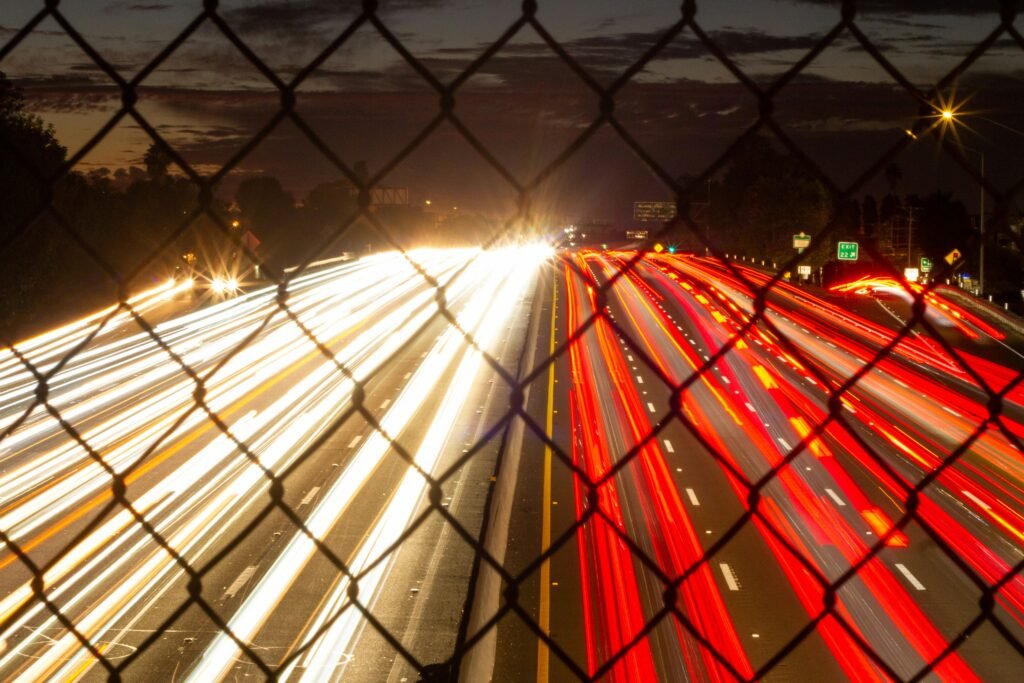
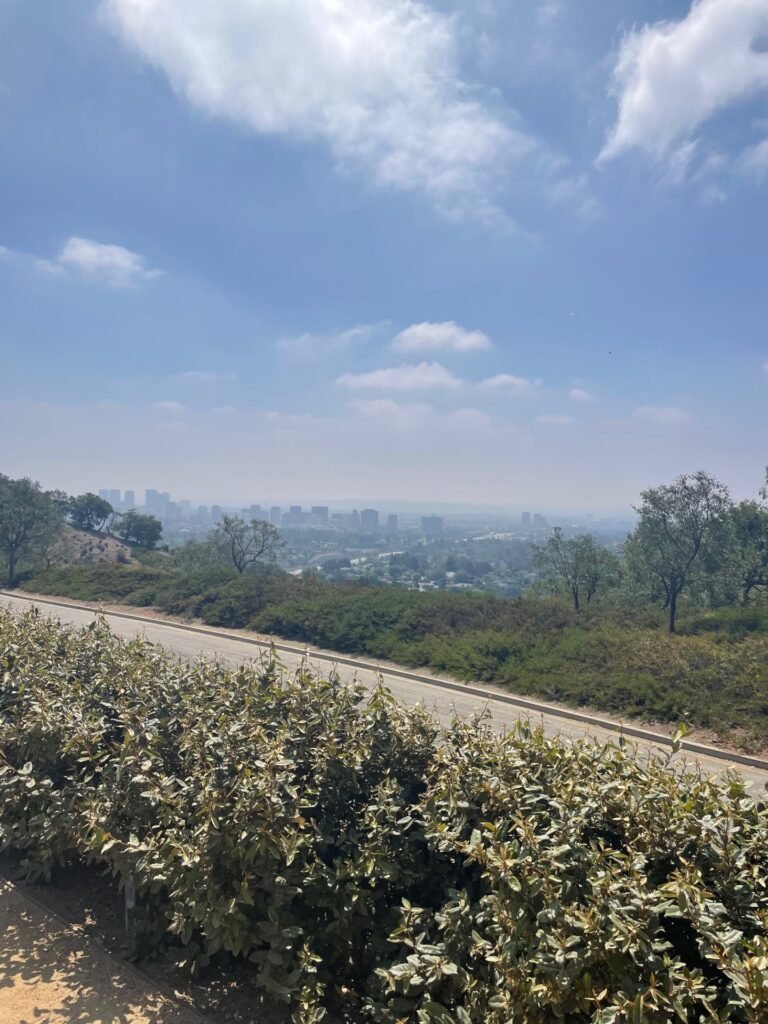
A true Angeleno learns to accept hours-long, traffic-laden commutes as part of everyday life – the strange convenience of spending a large portion of it sitting still. It’s a quiet contradiction, set against the city’s stereotypical image, ironically shaped by the Hollywood dream: all green juices, skinny wellness culture, and sunlit ambition. And then there’s the air itself – the pollutants that hang above it all, subtly clouding that picture-perfect blue sky. The dream is still there, of course, but it’s not always as clear as it first appears.
It’s all so consuming, and I still don’t quite know how to explain it to my friends back home in England. Even trying to walk short distances feels… embarrassing. It becomes a topic of conversation with the colleagues who see you commit the cardinal sin … rather than just a normal part of your day.
I think it’s kind of turned me into a sort of recluse. Not wanting to be seen walking. Not wanting to invite the questions. It’s given me a lot of grief … having a kind of out-of-body experience watching myself transform from unapologetically adventurous when I arrived in the city to all those brutal in-betweens that have chipped away at me, deeply etched into the person and how I view the city today.
And yes, it includes the time, a year ago, when a homeless man came out of the blue, stripped completely naked and was ready to pounce during my super early morning walk to work – and it was the passing cars, those same symbols of elite functionality, that ended up pulling over and stepping in to help me, a damsel in distress. That same night, my bed shook ferociously while I was in bed. Earthquake, duh. But panic churned through my veins like never before … I had thought it was the same guy under my bed. I decided that night to never walk to work again.
It’s been a whirlwind, and very clearly, I’m not exactly Carol Danvers swooping in to save the day on a jam-packed train, but I have been fighting – just in a different way. To reclaim that version of me that didn’t feel so constrained once upon a time. And maybe that’s what this has all been leading me towards: the realization that my time in L.A. might be coming to an end. That perhaps I’m better suited to the towns and cities of the East Coast – places threaded together by public transport, where movement feels shared, not solitary and isolating. Where I can explore the American dream in a way that feels a little closer to home.
On the other hand, my view might change in the years to come. There have been expansions to L.A.’s Metro system in recent years – most recently the connection to LAX’s new transit center and the automated People Mover aimed at significantly reducing car traffic around the airport.
There’s also a broader ambition at play. With Los Angeles preparing for the 2028 Summer Olympics, officials have been pushing a “transit-first” approach – expanding rail lines, increasing bus capacity, and encouraging residents and visitors to rely less on cars, as LAist has reported. But the city is still so vast, so sprawling, that it’s hard to imagine those changes making a truly transformative impact any time soon.
But while Hollywood hasn’t quite caught up yet, filmmakers have long understood the relationship between cities and how we move through them. As Collateral director Michael Mann has previously emphasized, a city’s infrastructure isn’t just background – it shapes behavior, mood, and story.
Back when Jan De Bont’s Speed was released, it captured a moment where public transport in Los Angeles felt novel enough to be cinematic – something worth building an entire film around. But more than three decades on, I don’t think that perception has really shifted.
Which raises the question: if the way people move through L.A. is changing, will the way we see it on screen begin to change too? Or will L.A. continue to be a city best experienced on-screen from behind the wheel? And will I be around to see the change in L.A?
It’s worth ending this piece with a loud and clear disclaimer: this isn’t about shitting on L.A.’s public transport or the people who rely on it daily – far from it. If anything, it highlights how essential easily accessible, safe, clean, connected transportation is … and how a car-free Los Angeles could do with a lot more TLC, both on & off-screen