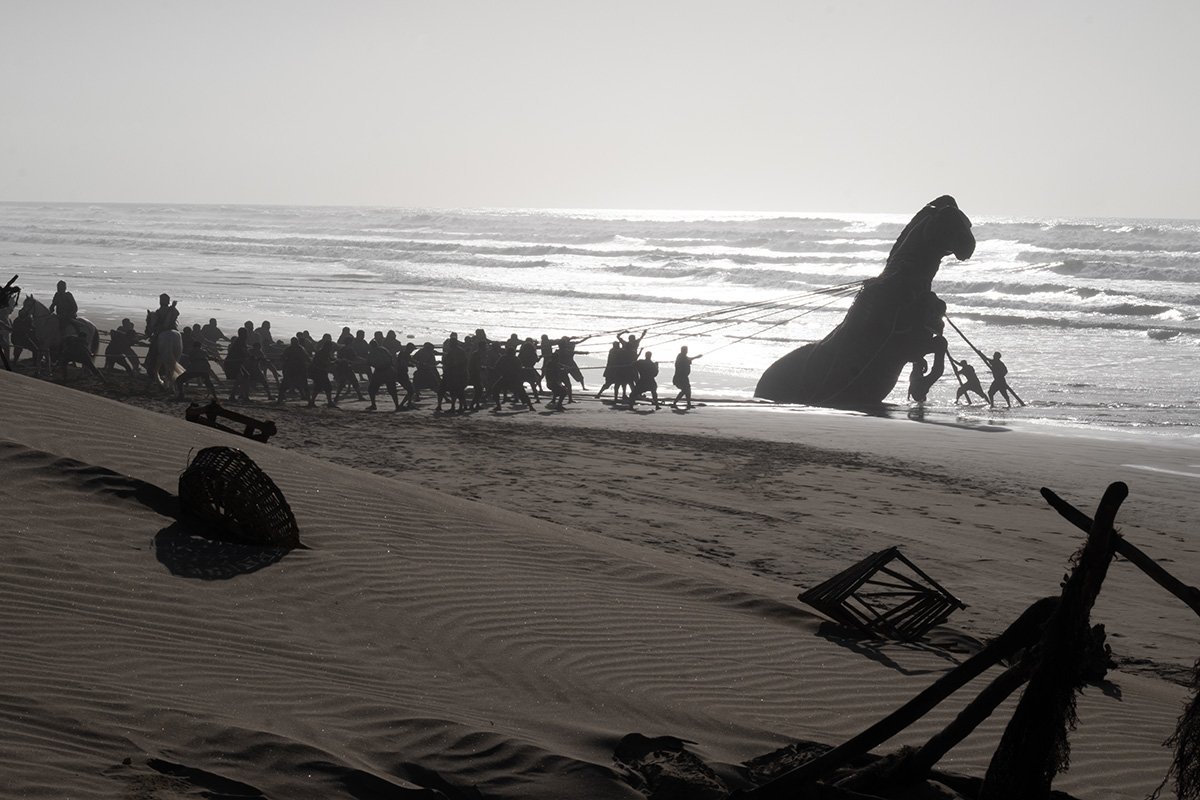
After spending years bending time, dreams, and atomic history on screen, Christopher Nolan is going even bigger with The Odyssey filming locations… because his adaptation of Homer’s ancient Greek epic is arguably his most ambitious location-driven production yet.
And fittingly, Nolan isn’t relying on green screens to tell the story. For The Odyssey, the director returned to one of the things that has defined his filmmaking for decades: real locations. From ancient coastal landscapes to remote islands and dramatic cliffs, the production spanned multiple countries to make Odysseus’ journey feel physically lived-in rather than digitally constructed.
So if, like me, you immediately started wondering where exactly Christopher Nolan filmed The Odyssey, here’s everything we know so far.
What is The Odyssey about?
Based on Homer’s ancient Greek poem, The Odyssey follows Odysseus, King of Ithaca, as he attempts to return home after the Trojan War.
The journey spans years and includes encounters with mythical creatures, gods, impossible landscapes, and emotional tests – all while his wife, Penelope, and son, Telemachus, wait back home.
When is The Odyssey released?
Christopher Nolan’s The Odyssey is currently scheduled for theatrical release on July 17, 2026
And because this is Nolan, the film is being positioned as a major IMAX theatrical event rather than a streaming-first release.
Who is in the cast of The Odyssey?
Confirmed cast includes:
Matt Damon – Odysseus
Tom Holland – Telemachus
Anne Hathaway – Penelope
Zendaya — Athena
Lupita Nyong’o – Helen of Troy & Clytemnestra
Charlize Theron – Calypso
Robert Pattinson – Antinous
Jon Bernthal – Menelaus
Benny Safdie – Agamemnon
Where was Christopher Nolan’s The Odyssey filmed?
Unlike many fantasy epics, Nolan pushed to shoot The Odyssey filming locations across real-world landscapes to preserve what he described as the physicality of the journey.
*Greece: Peloponnese, Pylos, Methoni Castle, Voidokilia Beach, and archaeological sites around Corinth. These locations were used to recreate key mythological environments and moments connected to Odysseus’ world.
*Morocco: Ouarzazate, Aït Benhaddou, Marrakesh. The landscapes doubled for ancient Troy.
*Sicily: Favignana, Lipari, Vulcano. Favignana is especially interesting because some historians associate it with the “Goat Island” referenced in Homer’s poem.
*Scotland: Findlater Castle and the remote regions of Iceland. The locations add colder, more isolated visual textures to parts of the journey.
Why Christopher Nolan chose real locations
One of the most interesting details to emerge from production was Nolan’s commitment to practical filmmaking.
According to comments Christopher Nolan made to Empire, the director wanted audiences to feel the physical reality of Odysseus’ journey, explaining that the production aimed to capture “how hard those journeys would have been for people” and the uncertainty of traveling through an “unmapped, uncharted world.”
The film also became the first feature shot entirely using IMAX film cameras, with new technology developed specifically for production.
That philosophy feels especially fitting for The Odyssey – especially since Homer’s story isn’t just about reaching a destination but more about what landscapes reveal about the people moving through them.
Can you visit The Odyssey filming locations?
The short answer: yes, many of them.
That might end up being one of the most exciting parts of Nolan’s adaptation.
From the beaches of Greece to Sicily’s islands and Morocco’s desert landscapes, many filming locations are already accessible to visitors — meaning The Odyssey could easily become one of cinema’s next great travel itineraries.